
Privacy mindset shifts
Sometimes a little ol' perspective shift is all you need

In our increasingly almost entirely digital world, privacy has become something of a luxury—a feature to be purchased rather than a fundamental right. But it's time to challenge this narrative and recognize that privacy isn't a premium add-on but something inherently deserved by every person navigating the online landscape. I truly believe this deep in my bones, and it’s part of the reason I’m here writing this, and why I spent 2 years creating privacy content on Instagram (which no longer exists - you can read more about that here).
Today I want to discuss some privacy mindset shifts that have been brewing within me. I hope they also resonate with you.
Privacy as a Human Right, Not a Premium Feature
Too often, we've accepted the notion that privacy is something we must pay for. Premium subscription tiers, paid apps, and exclusive services all promise to protect what should be automatically safeguarded: our personal information and digital autonomy.
The truth is simple yet profound: privacy is something you deserve just because you're a human on this earth. It's not a commodity to be traded, but a fundamental aspect of human dignity in the digital age. I wrote a blog about this for the non-profit I am on the board of - read it here.
Breaking Free from the Algorithm Echo Chamber
Consider how much of your day is spent online. For most of us, it's hours—scrolling, working, communicating, and consuming content. But there's a hidden cost to this digital immersion that goes beyond time.
When everything you see online is algorithmically curated to maximize your engagement and spending, the internet transforms from a tool of empowerment into an echo chamber and profit machine. Your feeds become carefully calculated reflections designed not to inform or enrich, but to keep you scrolling and purchasing.
This reality doesn't serve your best interests—it serves corporate bottom lines. And perhaps most troublingly, we've largely accepted this as the inevitable nature of the internet. I’m hoping that by you being here, you’re also not OK with this as “inevitable”, and we can work towards a different future.
The Low-Effort Privacy Myth
One of the most persistent myths about digital privacy is that protecting yourself requires technical expertise, significant time investment, or fundamental lifestyle changes. This misconception keeps many people from taking even basic steps to safeguard their information.
The truth is that caring about your privacy doesn't have to take a ton of effort. Many meaningful privacy protections are available through simple setting toggles and basic awareness. Small, incremental changes can significantly enhance your digital autonomy without disrupting your online experience.
Don't fall into the false belief that protecting your privacy is time-consuming and complex. It can be as simple as:
Reviewing privacy settings on your most-used platforms
Using a privacy-focused browser or search engine
Toggling off personalized advertising where possible
Being mindful about app permissions on your devices
Shifting the Privacy Paradigm
To reclaim our digital autonomy, we need to embrace several key mindset shifts:
From "I have nothing to hide" to "I have everything to protect" – Privacy isn't about concealing wrongdoing; it's about maintaining autonomy over your personal information.
From "convenience over privacy" to "convenient privacy" – Privacy-protecting tools have become increasingly user-friendly, reducing the perceived tradeoff between convenience and protection.
From "privacy is dead" to "privacy is evolving" – Rather than surrendering to digital surveillance as inevitable, recognize that privacy norms and tools are constantly developing.
From "individual responsibility" to "collective action" – While personal choices matter, we should also advocate for stronger privacy regulations and corporate accountability.
The internet doesn't have to be a place where we surrender our privacy for access. By shifting our mindsets around digital privacy and taking small but meaningful steps to protect ourselves, we can begin to create a healthier relationship with technology—one that respects our fundamental rights as humans in the digital age.
I’ll leave you with a little graphic keepsake:
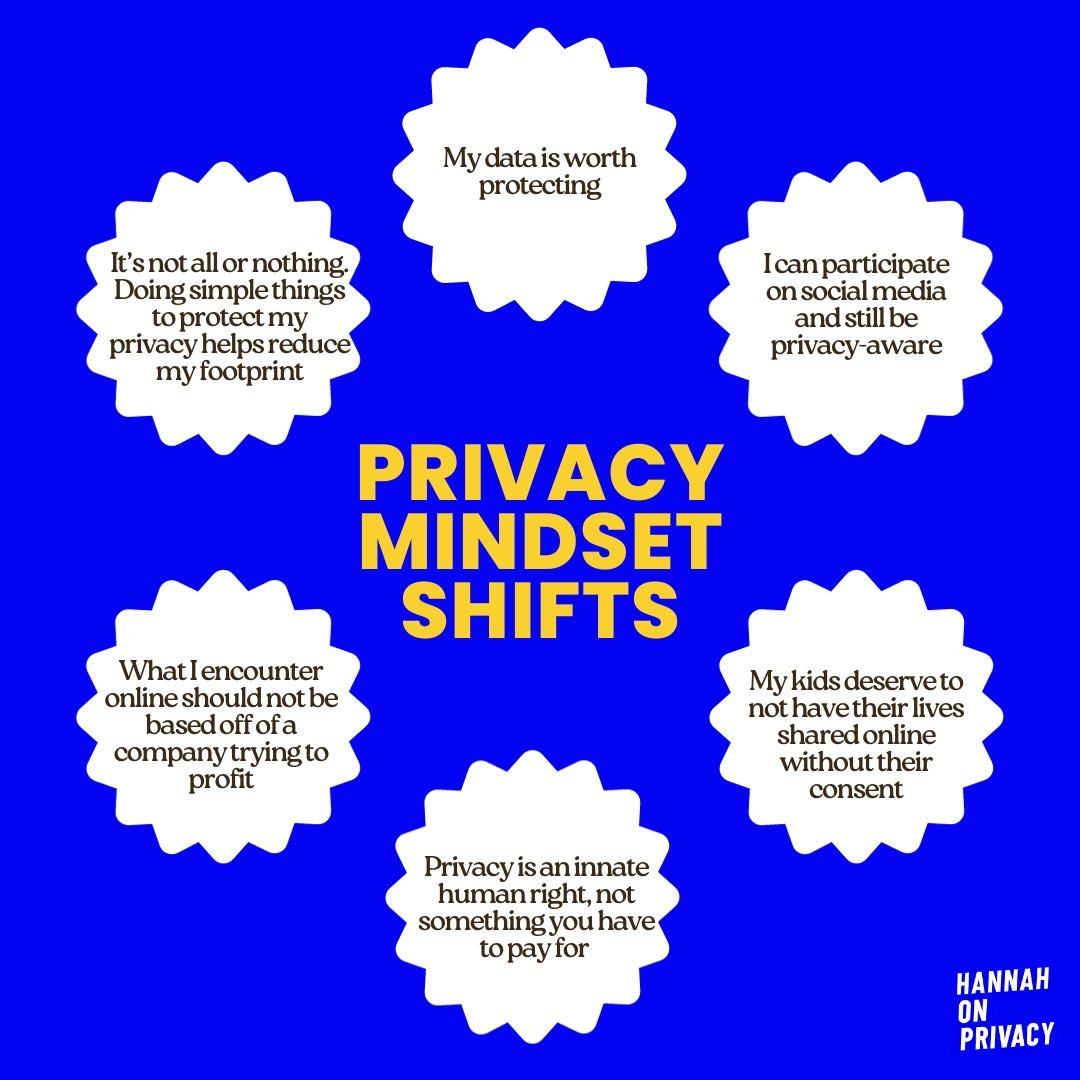
Thanks for reading, as always.
Hannah
I really like this:
** From "I have nothing to hide" to "I have everything to protect" – Privacy isn't about concealing wrongdoing; it's about maintaining autonomy over your personal information.**
I think if the average person were approached by a human asking them to see their phone, look at their photos and texts, make a copy, share & sell that information that this human got for free, it immediately turns into that "I have everything to protect." The average person isn't going to just hand their device over to a stranger.
And because of that, in my opinion, is where people fail to understand the importance of privacy. If a human was substituted for the cloud, or a large tech company, I think they'd change their view pretty quick. How weird would it be for a stranger to stand in your kitchen, listen to you, feed you advertisements based on what you talk about, and share that with their friends back home to profile you? Because that's Alexa...